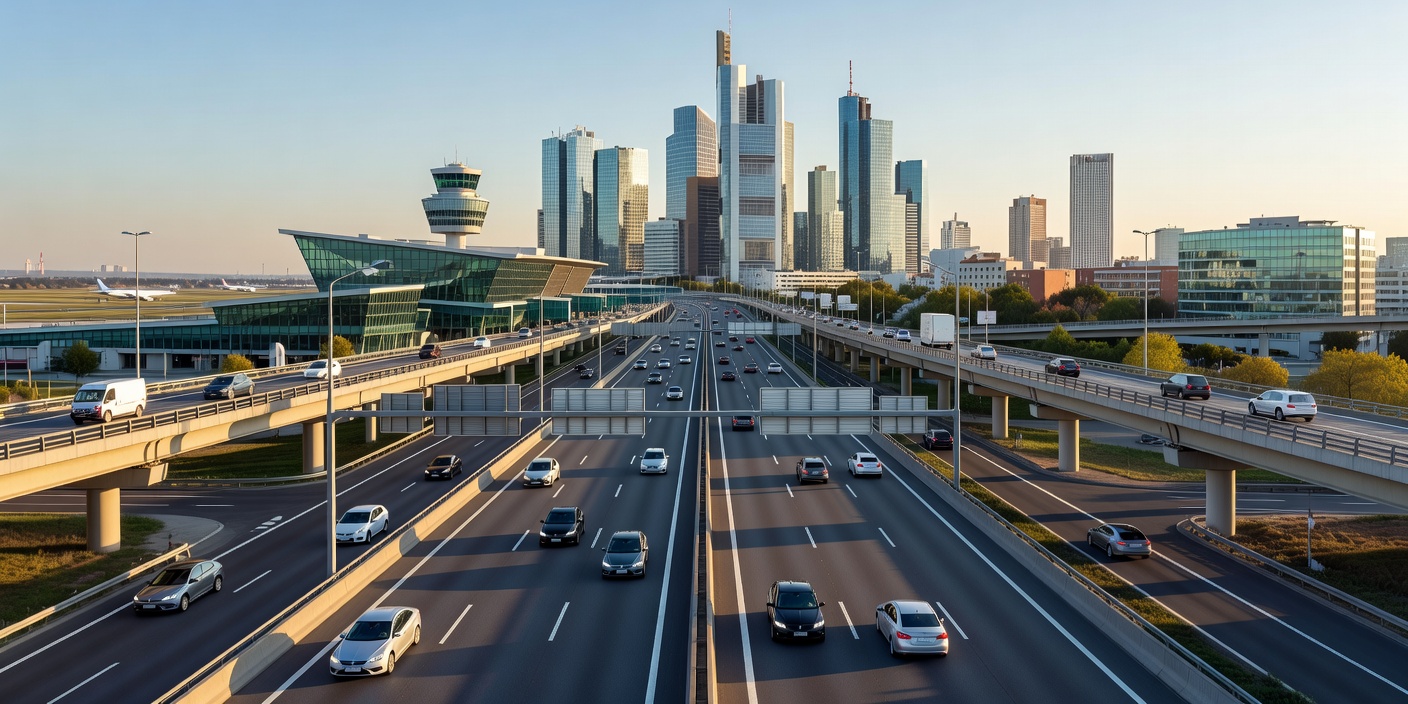
The Ring-Road Conundrum: Périphérique, M-30, and A10
Almost every major European capital relies on concentric ring roads to siphon traffic around its historic core. In Paris, the Boulevard Périphérique functions as a high-friction border; in Madrid, the M-30 and M-40 split commuter flows; while in Amsterdam, the A10 ring dictates whether a canal-side townhouse is reachable in thirty minutes or an hour and a half.
An experienced chauffeur does not blindly follow consumer navigation apps that reroute drivers down narrow residential alleys every time an expressway slows down. They understand the arterial choke points — such as bridge crossings over the Seine, Danube, or Thames — where sudden bottlenecks trap commercial traffic. By anticipating these bottlenecks, private transfer drivers take vetted secondary routes that preserve your schedule.
Comparing Airport Rail to Private Chauffeur Transfers
Travelers often ask whether high-speed airport express trains are a better alternative to road transit. Europe boasts some of the finest railway systems on earth, but transit value is entirely contextual.
If you are traveling alone with a light laptop bag heading to an office building immediately atop the central railway station, an airport express train makes great sense. However, if you are traveling with two large hardshell bags, a companion, or an infant, the train equation falls apart quickly. Navigating crowded railway platforms, non-functioning escalators, pickpocket risk during peak hours, and then hailing a secondary cab in the rain outside a central terminal erases any theoretical time savings. An executive transfer delivers door-to-door continuity without multiple points of luggage handling.
| Factor | Executive VIP Transfer | Express Airport Rail | Standard Street Taxi |
|---|---|---|---|
| Luggage Handling | Full porterage from arrival barrier to boot | Self-managed on platforms & stairs | Driver may assist at curbside |
| Route Directness | Direct to hotel lobby or private residence | Terminates at central station only | Direct, subject to city permits |
| Schedule Risk | Monitored flight tracking, driver waits | Fixed timetable; missed if flights delay | Subject to terminal queue length |
| Privacy / Focus | Private acoustic cabin with Wi-Fi | Public cabin; shared seating | Variable; no privacy partition |
Low-Emission Zones and Restricted Municipal Access
Over the past decade, European metropolitan areas have cracked down on urban vehicular pollution. In Italy, the Zona a Traffico Limitato (ZTL) triggers automated camera fines for unauthorized vehicles entering historic city centers. In Germany, the Umweltplakette mandates strict emissions badges, while London charges both Congestion and Ultra Low Emission Zone (ULEZ) levies.
Unsuspecting travelers booking informal ride services frequently find themselves dropped off at the perimeter of these zones because the driver lacks the required commercial municipal permit. Executive airport transfer fleets hold explicit permits, allowing them to glide directly past perimeter cameras and park right outside historic palaces, five-star boutique hotels, and pedestrian-priority zones.
Cross-Border and Intercity Connections
One of the distinct joys of European travel is the proximity of international frontiers. Landing at Geneva (GVA) might mean continuing into the French Haute-Savoie; landing at Vienna (VIE) often involves transit onward to Bratislava in Slovakia; landing at Basel-Mulhouse-Freiburg (BSL) literally presents a tri-national border inside the airport structure itself.
Executive chauffeur desks specialize in navigating these transnational transfers. They verify passport protocols, manage motorway vignettes (such as Swiss and Austrian highway permits), and ensure vehicles comply with neighboring road safety equipment laws — from emergency triangle requirements to winter tyre ordinances in the Alps.
Terminal Dispersion and Complex Hubs
European megahubs are notorious for sprawl. Terminals at Paris-CDG are miles apart, connected by transit shuttles that can take twenty minutes to navigate. Munich (MUC) features vast central plazas between its two terminals, while London Heathrow (LHR) spans across five sprawling zones.
Booking an executive transfer means you specify your flight number rather than guessing a pickup bay. The operations team maps the inbound arrival gate to the exact terminal exit, ensuring your driver is positioned at the precise passenger exit corridor closest to where your bags emerge from customs.