The Luggage Geometry Myth
When a car manufacturer states that an executive sedan has 500 liters of boot space, they are calculating fluid capacity using polystyrene test blocks. In real life, luggage consists of rigid polycarbonate shells, irregular duffel bags, suit carriers, and hat boxes.
Two standard airline check-in suitcases (usually 28 to 30 inches tall) will comfortably fill the horizontal depth of an executive saloon boot. If a party of three business colleagues lands with three full-sized check-in bags plus three rolling carry-ons, that luggage will not fit safely in the trunk of a standard sedan. Attempting to place an unbelted 23-kilogram suitcase on an empty rear passenger seat is illegal across most European jurisdictions due to occupant safety regulations during heavy deceleration.
Vehicle Classes: What You are Actually Choosing
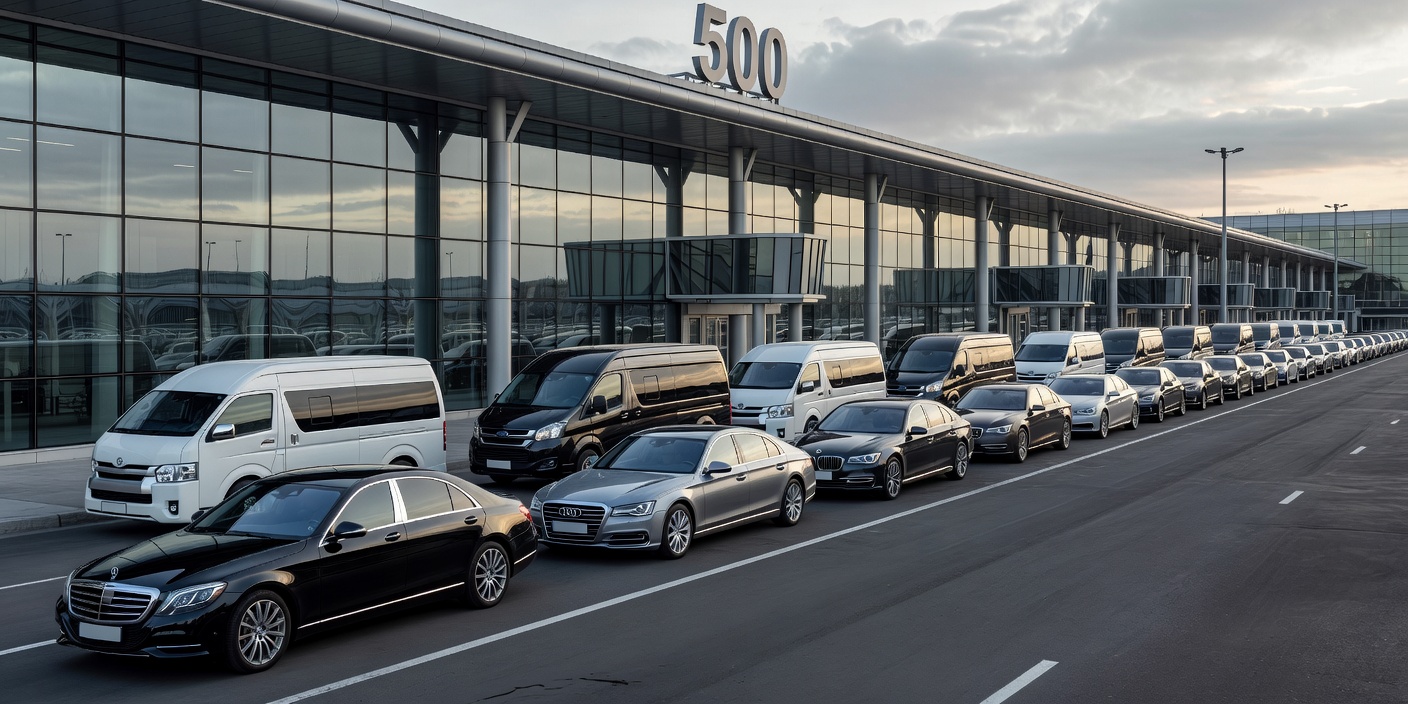
To avoid awkward airport curbside repackaging, European executive transfer operators typically organize their fleets into three standard functional categories:
Executive Saloon (E-Class / 5-Series)
Ideal for: 1 to 2 passengers with up to 2 medium check-in bags and 2 small carry-ons.
The Experience: Agile through narrow old-town streets, discreet for corporate work, quiet acoustic suppression.
First-Class Saloon (S-Class / 7-Series)
Ideal for: 1 to 2 passengers seeking maximum legroom and executive prestige, with 2 standard suitcases.
The Experience: Reclining rear seats, massage functions, independent zone climate control, pristine acoustic quiet.
Luxury MPV (V-Class / Multivan)
Ideal for: 3 to 7 passengers, or small families with heavy sports luggage, prams, or ski gear.
The Experience: Conference-style face-to-face seating, massive rear cargo bay, and easy step-in height.
The Hybrid Battery Factor
As European limousine operators shift toward plug-in hybrid (PHEV) and battery-electric vehicles (EV) to comply with zero-emission mandates in cities like London, Amsterdam, and Paris, vehicle interior geometry has evolved.
In plug-in hybrid executive sedans, the high-voltage traction battery is frequently housed beneath the luggage compartment floor. This raises the boot deck by three to five inches, lopping off significant vertical clearance. A trunk that previously accepted two stacked suitcases on their sides might now only allow them laid flat side-by-side, cutting overall baggage capacity in half. Professional booking desks calculate these specific dimensional nuances when you register your flight details.
People Carriers vs. Executive Vans: Not All Vans Are Equal
There is a world of difference between a utilitarian nine-seater airport shuttle bus and a luxury chauffeur-specification executive MPV. Budget airport shuttles use vinyl bench seating, commercial suspension tuned for cargo weight rather than passenger spine comfort, and manual sliding doors.
A high-specification Mercedes-Benz V-Class or Volkswagen Multivan Executive features rear air suspension that irons out road bumps, individual captains' armchairs upholstered in Nappa leather, dual electric sliding doors operated by the driver, independent rear air conditioning, and configurable face-to-face seating for mid-journey work sessions.
Practical Rule of Thumb for Booking
If your party consists of three or more adults traveling for longer than five days, always reserve a Luxury MPV over an Executive Sedan. The marginal fare difference is vastly outweighed by avoiding the stress of cramped legroom and crammed luggage.
Accessibility, Child Seats, and Special Equipment
European highway codes strictly enforce certified child safety seats (ECE R44/04 or R129 i-Size standards). In many European countries, placing a child under 135 centimeters in an adult belt carries heavy fines and immediate driver penalty points.
Unlike rideshare apps where finding an ISOFIX-equipped vehicle carrying the correct rear-facing infant seat is an unpredictable lottery, executive services install the required age-specific restraint before arriving at the terminal. Be sure to specify the child's exact age, weight, and height at booking so the correct seating can be fitted.