The Anatomy of the Curbside Bottleneck
When an Airbus A350 or Boeing 777 touches down at a hub like Frankfurt, Paris-Charles de Gaulle, or Amsterdam Schiphol, hundreds of passengers flood through customs within a thirty-minute window. Standard rideshare apps respond to this demand spike with automatic surge pricing algorithms, while available vehicles circle congested feeder ramps miles from your door.
Standard app algorithms calculate availability based on optimistic GPS proximity rather than actual terminal entry permissions. A driver may accept your trip while stuck in a bottleneck outside the drop-off zone, only to cancel after twelve minutes when airport transit police wave them along. In contrast, an executive airport transfer pairs you with a licensed professional whose vehicle is already safely parked in an authorized commercial holding facility, waiting for your specific flight transponder signal.
Meet and Greet vs. Parking Lot Hunting
The difference between these approaches becomes clear the moment you cross the sliding doors into the arrivals hall. With a standard on-demand app, you are typically instructed to make your way to "Parking Deck P3, Bay 41" — which invariably turns into dragging heavy cases across multi-level footbridges, descending service lifts, and squinting into the glare of matching hatchback headlights.
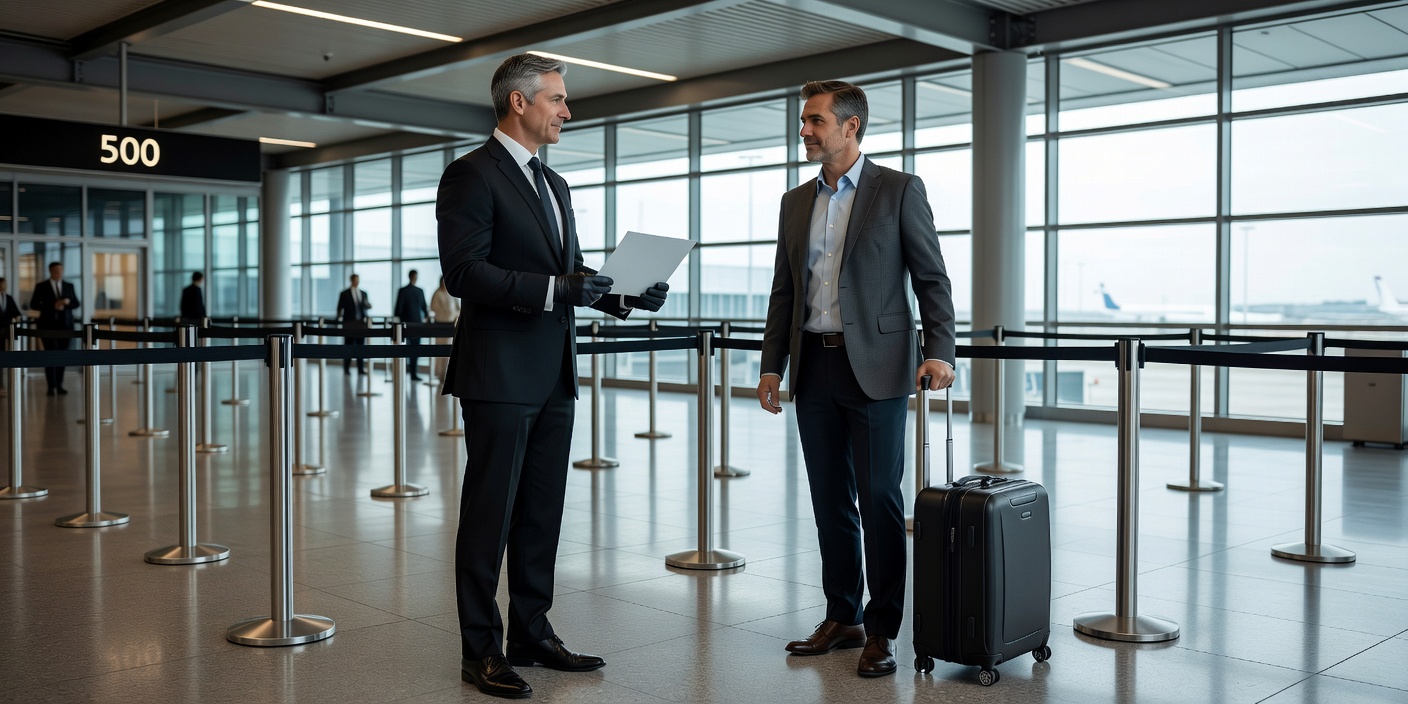
With an executive service, the chauffeur meets you in the terminal concourse immediately past the customs threshold. Holding an unobtrusive, personalized sign, they relieve you of heavy luggage and guide you through designated commercial VIP walkways directly into a pre-cooled vehicle parked in close priority spaces. You aren't navigating an airport parking lot; you are stepping straight into the next leg of your journey.
Key Difference: Chauffeur Licensing vs. Gig Driving
Chauffeurs operating executive transfers across the European Union undergo rigorous territorial examinations, maintain commercial public-hire passenger insurance, and are legally bound to honor advance bookings regardless of localized traffic surges.
Cabin Environment and Mobile Productivity
For the business traveler, transit time is either salvaged work time or quiet decompression. Standard street taxis often present an unpredictable cabin environment: blaring radio broadcasts, personal phone conversations on speaker, lingering tobacco scents from previous breaks, or broken USB charging ports.
Executive saloons (such as the Mercedes-Benz S-Class, BMW 7 Series, or Audi A8) are engineered around acoustic isolation. Acoustic double-glazing filters out exterior diesel engine rumble and highway tyre hum, giving you an environment where an impromptu client conference call or document review can happen without raised voices. Discreet Wi-Fi connections, universal mains charging plugs, rear climate controls, and professional chauffeurs who speak only when spoken to create an authentic mobile workspace.
Route Integrity and Local City Center Access
Many European municipal councils have introduced strict vehicle regulations to curb congestion and air pollution. Cities like Milan, Madrid, and Paris now enforce Low Emission Zones (Crit'Air, ZBE, Area C) that ban older or uncertified vehicles during business hours.
Because executive transport fleets are registered commercial passenger vehicles meeting Euro 6 or zero-emission battery standards, they carry authorized municipal permits allowing direct access to historic centers, pedestrian corridors, and hotel forecourts. An unlicensed rideshare may be forced to drop you three blocks away from your hotel's cobblestone entrance, leaving you to pull four bags up a steep curb in the rain.
Pricing Models: Transparent Fixed Fares vs. Volatile Meters
Perhaps the greatest relief of pre-arranged executive transit is pricing predictability. Taximeters continue ticking upward during rush-hour ring-road standstills, and app platforms multiply base fares by 2.5x during storms or rail strikes.
Executive services quote fixed, all-inclusive rates at booking. That quote covers airport parking fees, congestion charges, motorway toll gates, and guaranteed arrival waiting buffers. Whether your plane sits on the tarmac waiting for an open gate or you hit a thirty-minute queue at border control, your financial commitment remains fixed.